Guide
KitchenAid Gasket Replacement: Oven and Fridge Door Seals
How to test a KitchenAid oven or refrigerator door gasket, which seals you can swap yourself, and when a latch or sagging door needs a technician.
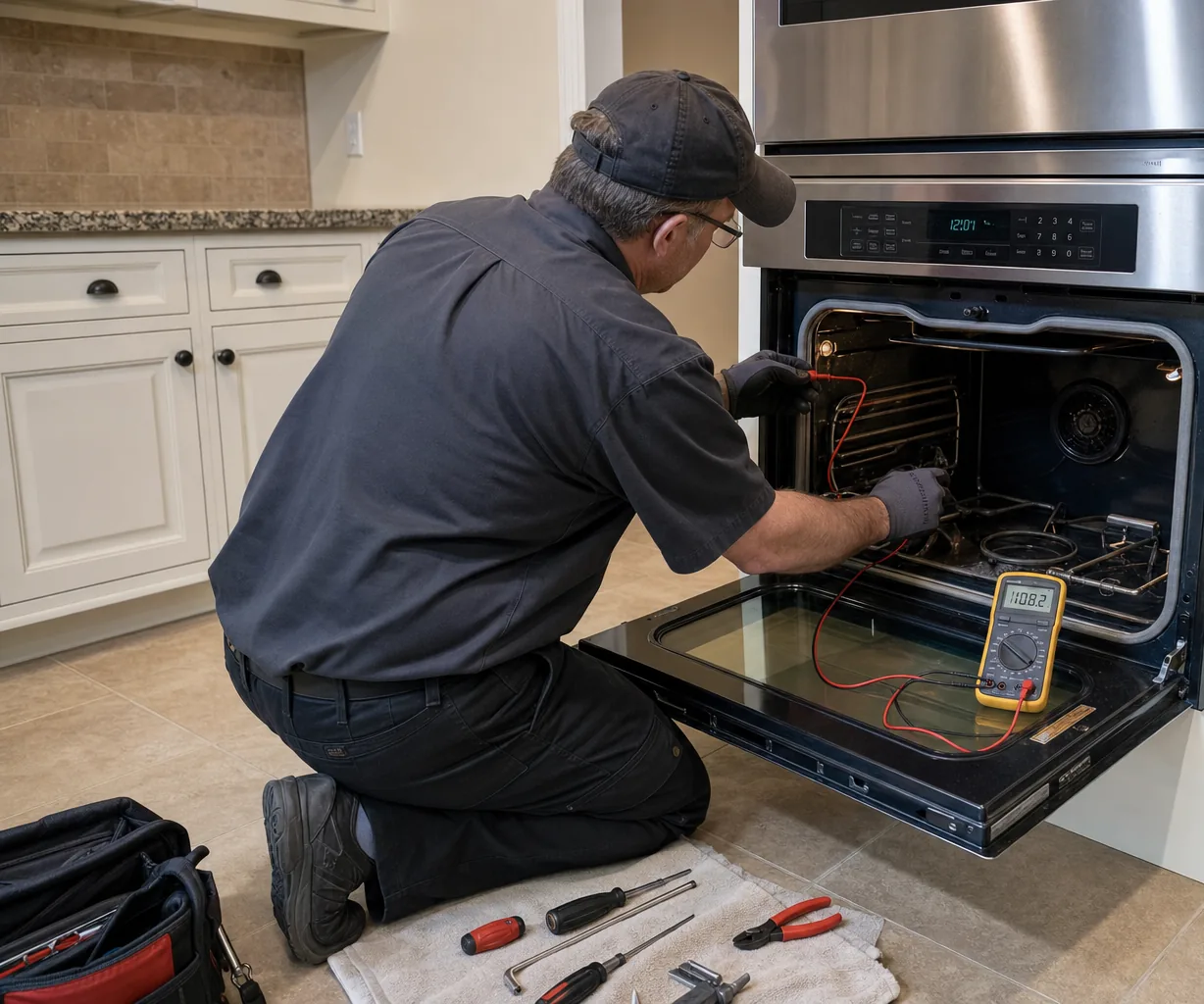
KitchenAid gasket replacement means pulling off a worn door seal and fitting the exact part listed for your model, and when a technician does the job the typical range is $150–$450, with the firm quote given on site after diagnosis. Before you order a part, run two quick checks, a paper test and a look at door alignment, because a door that closes crooked leaks just like a torn seal.
How do you know a KitchenAid door gasket is failing?
On most KitchenAid wall ovens and ranges, the oven seal is a braided fiberglass tube held by wire clips in the front frame of the oven cavity. With the oven off and cold, run your fingers along it. A healthy seal is round and springy; a failing one is flattened, frayed, brittle, torn at a corner or hanging where a clip has pulled out. While cooking, watch for heat or smoke curling out at the top of the door and a handle or control panel that runs hotter than it used to.
A refrigerator or freezer gasket is a soft vinyl strip with a magnet inside. Close the door on a strip of paper at several points; it should drag as you pull it out. If it slides out freely, that spot is not sealing. Sweaty door edges, frost on the freezer walls and a compressor that seems to run all the time are the everyday symptoms.
What does a leaking seal cost you in heat and cooling?
A leaking oven seal lets heat escape, so the elements or burners run longer to hold temperature. You get longer preheats, pale baking near the door and extra heat pushed toward the controls and the cabinetry around a built-in oven.
On a refrigerator, every gap pulls in warm, humid air, so the compressor runs more and frost builds faster. That frost is easy to mistake for a defrost failure, and a defrost heater or defrost thermostat repair typically runs $320–$550, so rule out the gasket first.
Gasket, latch or alignment: which one is the problem?
| Symptom or code | Likely cause | What the owner can check | When to call a technician |
|---|---|---|---|
| Heat or smoke at the top of the oven door | Flattened, torn or unclipped gasket; door not square | Look for gaps, loose clips and frayed corners, oven cold | Torn seal or a door that will not sit flush |
| Long preheat or uneven browning | Leaking seal or a temperature sensor fault | Check the calibration setting | Code 1d11 shows on a wall oven |
| F5 on a KitchenAid range | Door latch assembly, latch switches or wiring | Breaker off one minute, then watch one minute | The code comes back |
| Wall oven door locked after self-clean | Oven not yet cooled to about 200°F (95°C) | After a power failure, press Cancel/Off and wait 20–30 seconds | A manual latch still stuck after 30–90 minutes of cooling |
| Fridge sweating or freezer frost | Gasket not sealing, door sagging or out of level | Paper test; wash the gasket with warm soapy water | Frost returns within days |
F5 points to the latch and 1d11 to the sensor, control or wiring, so neither code is a reason to order a gasket.
Can you replace a KitchenAid gasket yourself?
Often, yes. A clip-in oven seal takes five steps:
- Find the model and serial tag, usually on the oven frame with the door open or behind the storage drawer on a range.
- Order the gasket listed for that exact model number; length, clip spacing and corners vary by model.
- With the oven off and fully cool, pull the old clips out of the frame one at a time.
- Push the new clips into the same holes, starting at the top center and working down both sides so the seal lies smooth without stretching.
- Close the door, repeat the paper test cold, then run a normal bake.
Many KitchenAid refrigerator gaskets press into a groove in the door liner; older designs sit under a screwed retainer. The fresh food and freezer doors usually take different gaskets, so name the exact door when you order, and warm a folded new gasket with a hair dryer on low until the kinks relax.
Call a technician when worn hinges keep the door from closing square, when the door has to come apart to reach the seal, or when French doors sit out of line. A new gasket will not fix alignment. For oven latches and hinges, see our wall oven repair and range and stove repair pages.
What does KitchenAid gasket replacement cost?
These are typical ranges; the firm quote is given on site after diagnosis:
- Door gasket or seal replacement: $150–$450
- Diagnostic or service call: $95–$149, credited toward the repair
- Range or oven repair, if the latch or hinge is the real fault: $250–$900
The repair pricing page lists the other bands. Katonah Wolf Appliance Repair is an independent service, not manufacturer-authorized, covering Katonah Village, Guard Hill, Cherry Street, Whitlockville, Bedford Hills, Cross River, Goldens Bridge and nearby towns. Call (475) 465-5086 to book.
How do you keep a new gasket sealing?
Before a high-temperature self-clean, KitchenAid says to remove racks, bakeware and foil, hand-clean the door edge and the 1½ in (3.8 cm) area around the cavity frame without moving the gasket, and move pet birds to another closed, ventilated room. Do not scrub the seal itself. On AquaLift models, the lower-heat clean uses 2 cups (16 oz [500 mL]) of distilled or filtered water on the cooled oven bottom and takes 40 minutes.
On a refrigerator, wipe the gasket with warm soapy water and keep shelves from pushing the door open.
Frequently asked questions
How much does KitchenAid gasket replacement cost?
A technician-fitted door gasket typically runs $150–$450, plus a $95–$149 diagnostic credited toward the repair. The firm quote is given on site after diagnosis.
Is a KitchenAid freezer gasket the same as the refrigerator door gasket?
Usually not. The freezer door or drawer takes its own gasket sized for that opening, so order by model number and name the door.
Is a KitchenAid mixer gasket the same kind of part?
No. A stand mixer gasket is a small seal in the mixer head that keeps gear grease in, and it has nothing to do with oven or refrigerator doors.
Should I check the oven with a thermometer after a new seal?
No. KitchenAid advises against it because the heat cycles on and off and opening the door changes that cycle. On some models, holding the Temp/Time down arrow for 5 seconds shows the offset, such as 0°F CAL, adjustable in 5°F (3°C) steps between 30°F (18°C) and -30°F (-18°C).