Guide
Wolf Oven Maintenance: A Cleaning and Care Schedule
How to clean and maintain a Wolf oven, range or cooktop: burner caps, grates, igniters, hood filters, door gasket and self-clean, with simple intervals.
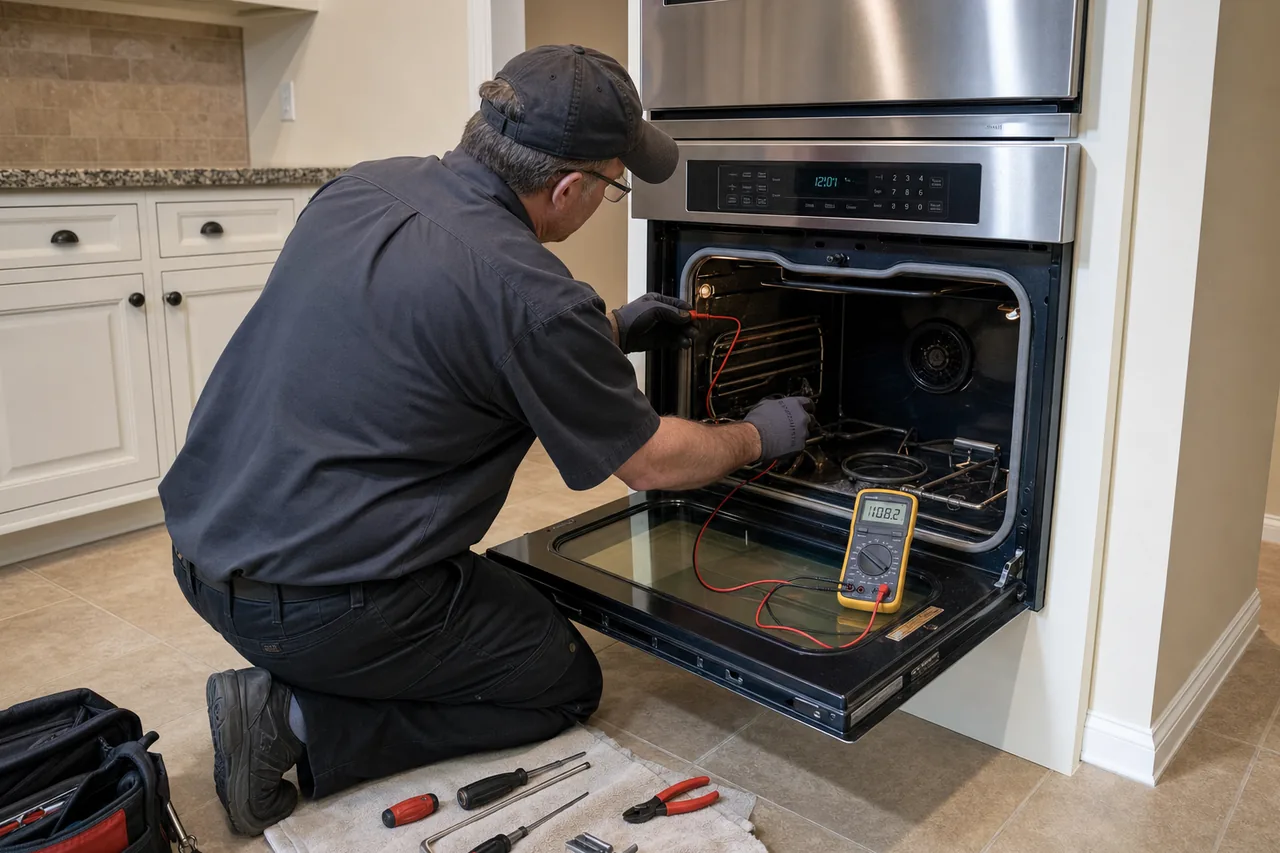
Wolf oven maintenance is a short, repeatable routine: wipe spills after every use, wash the burner caps, grates and hood filters about once a month, and check the igniters, door gasket and oven temperature every 6 months. Most of those jobs take under 20 minutes with warm soapy water and a soft cloth, and they head off the clogged burner ports, weak igniters and leaky door seals behind many oven and range breakdowns. Your use-and-care guide remains the final word for your exact model.
What should a Wolf maintenance schedule include?
| Task | How often | What to use or watch for |
|---|---|---|
| Wipe cooktop, knobs and oven door glass | After each use, once cool | Damp microfiber cloth, mild dish soap |
| Wash burner caps and grates | Monthly, or after a boil-over | Warm soapy water, nonabrasive pad; dry fully |
| Clean hood filters | Monthly with frequent searing or frying | Hot soapy water, or the dishwasher if the filter allows |
| Run self-clean or hand-clean the oven | Every 3–6 months | Racks out first; never on the day of a big meal |
| Inspect the door gasket | Every 6 months | Fraying, flat spots, gaps, heat escaping at the top of the door |
| Check oven temperature | Every 6 months | Oven thermometer set at 350°F |
| Watch the igniters | Every time you cook | Clicking that won’t stop, slow lighting, a gas smell |
How do you clean a Wolf oven?
If your oven has a self-clean cycle, it does the heavy work. Remove the racks, probe and any pans first, because the cycle heats the cavity to roughly 800–900°F and discolors racks. Wipe up pooled grease to cut smoke, and expect the door to stay locked for several hours. Afterward, wipe out the ash with a damp cloth.
Two rules protect the parts most likely to fail. Don’t touch the door gasket with cleaner or a scrubber; it is woven fiberglass and frays easily. And run self-clean at least a week before holiday hosting, since the extreme heat is hard on thermal fuses, door locks and control boards.
How do you clean a Wolf gas oven by hand?
Many all-gas Wolf range ovens have no self-clean cycle. Let the oven cool completely, take out the racks, and spread a paste of baking soda and a little water over baked-on spots, keeping it away from the gasket, the burner opening in the oven floor and the igniter. After 30 minutes or overnight, lift it off with a plastic scraper and rinse. Skip steel wool and caustic oven sprays, which can scratch or etch the porcelain enamel. Wash racks in the sink and dry them before reinstalling.
How do you care for burners, caps and grates?
Wolf sealed burners need clean, dry ports to light evenly. Lift the caps off a cool cooktop, wash them in warm soapy water, and clear blocked ports with a straight pin; a toothpick can break off inside. Dry every piece, then reseat each cap flat and centered. A cap that rocks or sits off-center causes uneven flames and constant clicking. A healthy flame is blue with a small inner cone; yellow tips or lifting flames usually mean dirt or a misplaced cap.
Grates are porcelain-coated cast iron. Let them cool before washing, because cold water on a hot grate can crack the coating, and use a nonabrasive pad. On the control panel, spray cleaner onto the cloth, never at the knobs, so liquid doesn’t reach the spark switches behind them.
Why do igniters click or light slowly?
Burner igniters are small ceramic electrodes beside each burner. After a boil-over they often click nonstop because water or salt is bridging the spark; wipe the electrode dry and give it a few hours before deciding anything is broken.
Gas ovens use a hot-surface igniter that glows before the gas valve opens, and as it weakens the oven takes longer to light. If the oven hasn’t lit within about 90 seconds of the igniter glowing, turn it off; a tired igniter is a common reason for a Wolf range repair visit. If you smell gas, shut the appliance off, ventilate and call your gas utility.
When should you check the door gasket and oven temperature?
Every 6 months, look over the gasket with the door open. Fraying, flattened sections, gaps at the corners or soot streaks on the frame mean heat is escaping, which stretches preheat times and leaves bakes uneven.
For temperature, put an oven thermometer on the middle rack, set 350°F and read it 20 minutes after preheat ends. A swing of 10–15 degrees is normal as the burner or element cycles. If it reads 25°F or more off on every check, many Wolf ovens offer a temperature offset you can adjust; if the problem persists, the sensor or controls may need Wolf oven repair.
What about hood filters and steam ovens?
Greasy hood filters reduce airflow and hold flammable grease above the burners. Many stainless baffle filters can go in the dishwasher; mesh filters do better soaked in hot soapy water.
A Wolf steam oven needs its own care: empty and dry the water reservoir after use and run descaling when the oven prompts you. Many homes around Katonah, Cross River and North Salem draw from private wells, and mineral-heavy well water can bring those prompts sooner, so filtered water helps.
When is it time to call for repair?
Call when cleaning and drying don’t fix it: an oven that won’t heat, an igniter that won’t light, a torn gasket, or a self-clean door that stays locked. Katonah Wolf Appliance Repair is an independent service, not manufacturer-authorized, and serves Katonah, Bedford Hills and nearby towns at (475) 465-5086. Typical ranges are on our pricing page; the firm quote is given on site after diagnosis.
Frequently asked questions
Can I use oven cleaner in a Wolf oven?
Avoid commercial oven sprays in a Wolf oven. They can damage the porcelain enamel and the door gasket, so use the self-clean cycle or a baking soda paste instead.
How often should I run the self-clean cycle?
Every 3–6 months suits most households. Run it sooner if residue smokes during preheat, and always well ahead of a big meal.
Why does my Wolf burner keep clicking after I cleaned it?
Usually the burner is still damp or the cap isn’t seated flat. If drying and reseating don’t stop it, the spark switch or module may need service.
What does a Wolf oven repair typically cost?
A diagnostic or service call typically runs $95–$149, an igniter or bake element $250–$500, and a door gasket replacement $150–$450. These are typical ranges, and the firm quote is given on site after diagnosis.